Skip the Expensive Laptop: Why Some Road Warriors Ship a Mini PC Instead
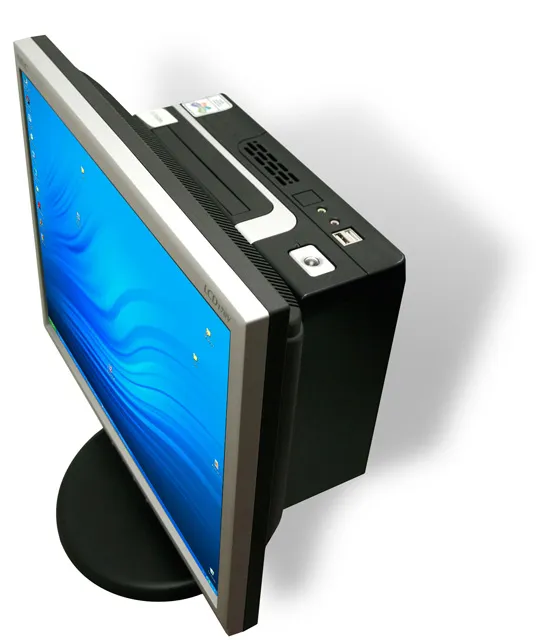
Photo: SergeyAK, CC BY-SA 3.0, via Wikimedia Commons
Here's a setup that gets you laughed out of most tech discussions: fly to your destination with nothing but a lightweight, $500 notebook, and have a full-power desktop mini waiting for you at the other end. No 4-pound workstation in your carry-on. No thermal throttling on a hotel desk. Just a machine the size of a peanut butter sandwich, shipped ahead or left behind, doing all the heavy lifting.
It's unconventional. It's also quietly gaining traction among a specific breed of mobile professional — and after living with the setup for a quarter, I think the laughers are missing something.
The Core Idea
The logic is simple: you're already paying for space at your destination. That Airbnb in Scottsdale, the corporate apartment in Chicago, the client's office in Denver — all of it has a desk, a monitor (or a TV with an HDMI port), and a power outlet. So why carry a $2,500 thermal-squeezed laptop to duplicate what a $600 mini PC can do better when it's plugged in?
The modern mini PC — think NUC-style boxes and their many descendants, or newer entries built around efficient mobile chips — now packs genuine workstation-class performance into a chassis that weighs under two pounds. For sustained workloads, it has a decisive advantage: it doesn't throttle the way a thin laptop does, because it isn't fighting its own chassis for airflow. Plug it into a real monitor and it outperforms machines three times its price for editing, compiling, and CAD work.
The Travel Math
Now the logistics, which is where the idea gets interesting — and where it falls apart for some people.
Option one: ship it. A mini PC in its original box, insured, runs $20–60 to ship domestically. Do that for a month-long engagement and you've spent less than the weight penalty of carrying a workstation laptop would cost you in airline fees, back pain, and carry-on real estate. Ship it back when you leave.
Option two: leave one there. If you're a regular at a destination — a snowbird split between Florida and Michigan, a consultant with a recurring client site — park a mini PC at each location permanently. Your total travel kit shrinks to a sub-3-pound ultralight and a phone. This is where the economics get genuinely compelling: two $600 minis still cost less than one flagship laptop.
Option three: the compute stick compromise. The smallest options plug directly into a TV's HDMI port. Performance is modest, but for email, docs, and browser-based work, it's a full desktop in your jacket pocket.
Who This Actually Works For
This setup is not for everyone, and pretending otherwise would be dishonest. It works best for:
- Repeat visitors with a stable destination and a desk waiting there.
- Heavy-workload professionals — video editors, developers, engineers — whose laptop is a compromise they've been resenting for years.
- Anyone whose travel is predictable enough to plan a shipment a few days ahead.
It fails for digital nomads hopping cities weekly, for anyone working primarily from cafés and coworking spaces with no dedicated monitor, and for people who need their entire digital life on one machine at all times. If your destination has no screen, you're carrying a very expensive brick.
The Security Ledger
One trade-off deserves its own paragraph. A shipped or parked mini PC holds your data in a location you don't fully control — an apartment, a client site, a shipping warehouse. Encrypt the full disk, keep nothing sensitive in local storage that isn't also backed up elsewhere, and treat the device as expendable. If losing it wouldn't ruin your week, you've configured it correctly. The laptop that travels with you, by contrast, never leaves your sight — which is its own kind of security the mini PC can't match.
The Uncomfortable Conclusion
The laptop won the portable computing war so thoroughly that we forgot it was a compromise: desktop power squeezed into a battery-powered chassis that throttles, overheats, and costs a fortune. The mini PC travel setup doesn't beat the laptop at everything. It beats it at the one thing that matters most to a certain kind of worker — sustained, serious performance at a desk you didn't have to carry with you. If that sounds like your life, it might be time to stop hauling your desktop around and start shipping it.