Your Laptop Costs $2,000. Your Bag Is What Gets It There in One Piece.
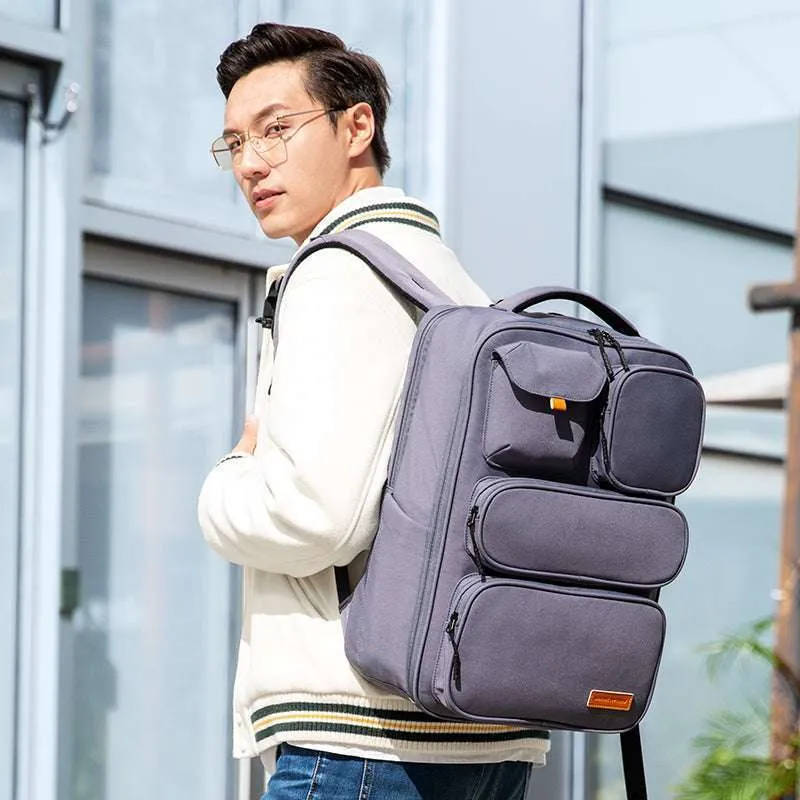
Photo: laptop backpack commuter urban professional, via markrydenfactory.com
There's a peculiar ritual every mobile worker knows: the laptop gets researched for weeks, benchmarked, compared, and finally purchased with the care of a firstborn child. Then it goes into whatever bag was cheapest at the register. That's backwards. Your machine doesn't protect itself — your bag does. And after years of hauling gear through Penn Station, O'Hare, and a suspicious number of Portland coffee shops, I can tell you the bag decision shapes your workday more than three extra gigs of RAM ever will.
The Three Contenders
Every carry solution falls into one of three camps, and each one is quietly optimized for a different kind of worker.
The backpack is the default for a reason. Two straps mean your shoulders share the load, which matters enormously when your commute involves a mile of walking or a crowded light rail car in Seattle. Modern laptop backpacks — think along the lines of what Peak Design, Aer, or Timbuk2 are building — have suspension-style straps and back panels that move weight off your spine and onto your hips. A well-fitted pack carrying 15 pounds feels like half that. A bad one feels like a slow-motion injury.
The sling is the minimalist's answer. One strap, quick rotation to the front for grabbing gear, and just enough room for a 13-inch machine, a charger, and a notebook. If your office is a different café every day and you've Marie Kondo'd your kit down to essentials, a sling beats a backpack on pure convenience. The catch: all that weight lands on one shoulder. Two hours is fine. A full trade-show day at the Las Vegas Convention Center is not.
The roller case is the one everybody laughs at until they hit 40. If your travel pattern involves airports more than sidewalks, rolling your office beats carrying it every single time. The trade-off is obvious — stairs, snow, cobblestones, and crowded subway turnstiles are all roller-hostile environments — but for the consultant flying DTW to DFW twice a week, it's not even a debate.
What Actually Matters When You're Shopping
Spec sheets for bags are nearly useless. Instead, run every candidate through these five filters.
Weight distribution. Put the empty bag on. Then imagine it loaded. A laptop should sit against your back, high in the compartment, close to your center of gravity. If the laptop sleeve is at the bottom of a deep pit, walk away — that design turns every step into a pendulum swing.
The charging pass-through pocket. This is the feature that separates 2024-era bags from everything before it. A dedicated pocket for a power bank with a cable pass-through lets you charge your phone from your pocket while the bank rides in the bag. On a six-hour travel day, this is the difference between landing with a dead phone and landing with your boarding pass, your map, and your podcast queue intact.
TSA-friendly layout. A true lay-flat laptop compartment — one that unzips so the machine lies flat on the X-ray belt without removing it — saves you thirty seconds per airport security line and, more importantly, means you're never the person holding everyone up at 6 a.m. in Atlanta. Bonus points if the compartment is separate from your main storage, because TSA agents have a habit of "reorganizing" loose items.
Weather resistance. Not waterproof — weather resistant. Coated zippers, a DWR-treated shell, and a flap over the main opening. Anyone who's sprinted from an L stop in a Chicago downpour knows exactly why this matters.
Real capacity honesty. Manufacturers list liters, but nobody thinks in liters. Here's the translation: under 15 liters is phone-wallet-keys territory plus a small laptop. 15 to 22 liters handles a laptop, charger, headphones, and lunch. Above 25 liters, you're carrying a weekend bag, and your shoulders know it by 3 p.m.
The Airport Reality Check
Air travel is its own special exam. Your bag needs to slide under the seat in front of you — which rules out most fully-packed 25-liter backpacks on regional jets. It needs a luggage pass-through strap if you're also dragging a checked bag. And it needs to survive being gate-checked when the overhead bins fill up on the first boarding group, which they always do.
If you fly more than a dozen times a year, prioritize the lay-flat compartment and a top grab handle rated for the bag's loaded weight. That handle gets used more than any other feature you own.
The Verdict
Here's the uncomfortable math: a $2,000 laptop in a $200 bag is a $2,200 setup that lasts five years. A $2,000 laptop in a $25 bag is a $2,025 setup that lasts until the first time you set the bag down too hard on concrete. Buy the bag like the machine inside it matters — because it does.