Everything But the Kitchen Sink: How Your Go-Bag Became a Portable Data Center
There's a moment every frequent traveler knows. You're standing at an airport security line, hoisting your bag onto the conveyor belt, and the thing lands with a thud that makes the TSA agent raise an eyebrow. Your laptop? Three pounds, maybe three and a half. Your bag? Closer to fifteen.
Somewhere between buying a featherlight ultrabook and actually using it in the wild, something went sideways. Your quest for mobility quietly turned into a logistics operation.
Welcome to what we're calling the Backpack Tax — the invisible overhead that accumulates around every portable workstation, one "just in case" item at a time.
How Peripheral Bloat Actually Happens
It doesn't start all at once. Nobody wakes up one morning and decides to pack three different USB-C cables of varying lengths plus a legacy Micro-USB "just in case." It happens incrementally, the way clutter always does.
You get burned once by a dead laptop in a coffee shop with no outlet nearby, so you add a power bank. Then you realize your power bank can't fast-charge your laptop, so you keep the original charger too. A client meeting requires a wired HDMI connection, so a dongle goes in the bag. You forget it once and miss a presentation, so now a backup dongle lives there permanently. And so on.
Each individual decision is completely rational. The cumulative result is not.
This is peripheral bloat in its purest form — a slow accumulation of gear driven by anxiety rather than actual workflow analysis. And the weight isn't just physical. There's a real cognitive load that comes with managing a sprawling kit: remembering what you packed, digging through the bag to find it, worrying mid-flight whether you grabbed the right cable.
Running the Numbers on Your Portability Overhead
Let's get concrete for a second. Pull out your go-bag and actually weigh what's in it. Most people are genuinely shocked.
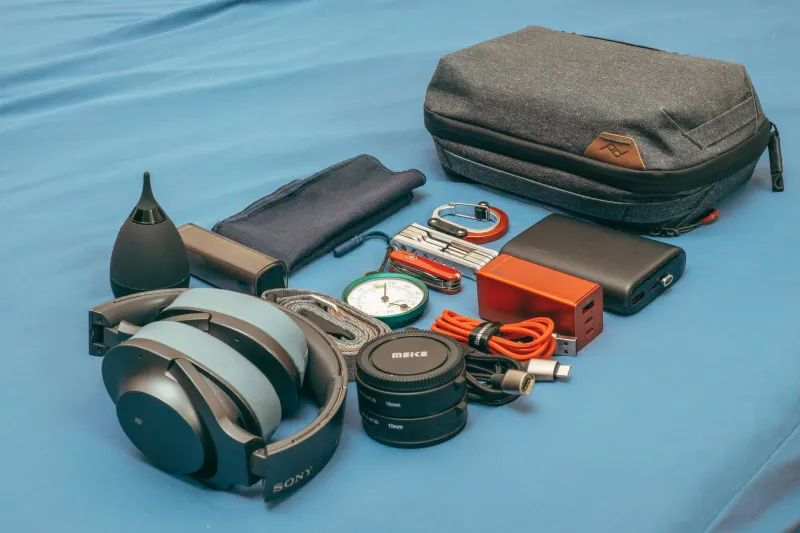
A typical "I travel light" mobile setup might include:
- Laptop: 3.2 lbs
- 65W USB-C charger + cable: 0.6 lbs
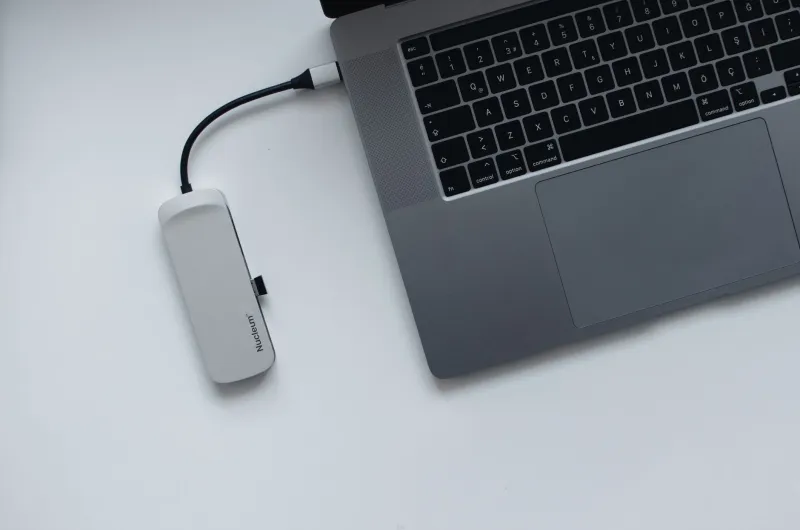
- USB-C hub or dongle: 0.3 lbs
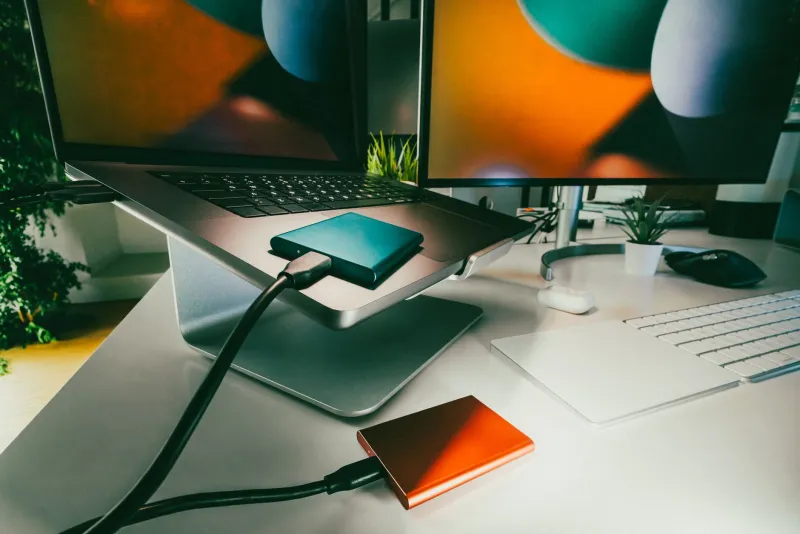
- External SSD: 0.2 lbs
- Wireless mouse + USB receiver: 0.3 lbs
- Power bank (20,000 mAh): 1.1 lbs
- Laptop stand (folding): 0.8 lbs
- Miscellaneous cables: 0.5 lbs
- Earbuds + case: 0.2 lbs
- Notebook, pens, etc.: 0.5 lbs
That's roughly 8 lbs before you add water, snacks, or the bag itself. A decent daypack adds another 1.5 to 2 lbs empty. You're now carrying close to 10 lbs on your shoulder for a workday that could theoretically run on a single device.
For a five-day work trip, multiply that by every flight, every Uber, every walk between terminals. That weight has a real cost — in fatigue, in back strain, and in the friction it adds to every transition between locations.
The Psychology of "Just in Case"
Here's the uncomfortable truth: most of what lives permanently in your bag is insurance against scenarios that rarely materialize.
That Ethernet adapter? You've used it twice in two years. The extra charging brick for the laptop you no longer own? Still in there. The three-foot HDMI cable because the conference room might not have one? The conference room has had one every single time.
We overpack because the cost of not having something feels more immediate than the cost of carrying something unnecessarily. Missing a cable in a clutch moment is memorable and painful. Hauling an extra half-pound across twelve cities is a slow, invisible drain that never registers as a single bad event.
But it adds up. And it keeps you from being truly mobile.
A Framework for Auditing Your Kit
The goal isn't to strip your setup down to a laptop and good vibes. It's to make deliberate choices about what earns a permanent slot versus what's context-specific.
Step 1: Track actual usage for 30 days. Keep a simple note on your phone. Every time you pull something out of your bag and use it, log it. After a month, you'll have real data instead of assumptions. You'll probably be surprised how many "essentials" never came out.
Step 2: Separate your everyday kit from your travel kit. These should not be the same bag. Your daily setup for coffee shop hopping needs different gear than a three-city business trip. Build two distinct lists and stop letting travel anxiety bleed into your everyday carry.
Step 3: Apply the one-in-one-out rule for accessories. Before adding any new peripheral to your bag, identify what it's replacing or what you're willing to leave behind. If nothing comes out, the new thing doesn't go in.
Step 4: Question redundancy ruthlessly. Do you need both a full-size charger and a power bank? Maybe — but can the power bank handle laptop charging, making the charger a context-specific item rather than a daily carry? Often, one well-chosen piece of gear can replace two mediocre ones.
Step 5: Embrace venue-specific gear. If you work from the same coffee shop three days a week, consider leaving a charging cable there. If you have a dedicated desk at a coworking space, keep a hub there permanently. Not everything needs to travel with you everywhere.
The Gear That Actually Earns Its Weight
None of this means you should suffer through an underpowered, under-equipped mobile setup. Some gear genuinely justifies the overhead.
A compact GaN charger that handles both your laptop and phone in a single brick? Absolutely worth it — it replaces two items and saves space. A quality folding laptop stand if you're logging serious hours away from a desk? Your neck will thank you. A slim, high-capacity power bank that can actually charge your laptop? Yes, but it should replace your brick in low-risk situations, not stack on top of it.
The question to ask for every item: Does this enable something I couldn't do otherwise, or does it just reduce a risk that rarely occurs?
Mobility Is the Feature
Here's the thing about portable workstations that's easy to lose sight of when you're deep in gear research: the whole point is that you can move. The laptop that fits in a sleeve, the setup that deploys in 30 seconds, the bag you can carry all day without dreading the walk from the parking garage — that's the product.
When your go-bag becomes a burden, you stop going. You start avoiding the coffee shop because setup takes too long. You skip the trip because packing feels exhausting. You work from the same desk every day because mobility has quietly become more trouble than it's worth.
The Backpack Tax is real, and it compounds. Audit your kit, cut what isn't pulling its weight, and remember that the lightest setup you can actually work from is almost always better than the most complete setup you dread carrying.
Your back already knows this. It's time to listen.